Adopt an artwork
Become part of the story behind Stirling’s artworks.
The University of Stirling Art Collection has been at the heart of the University since it was founded. For those who visit, study or work at the University, the Collection offers inspiration, provocation and connection. It’s a cherished part of the lives of thousands of people every year, because art has the power to bring moments of joy and reflection into everyday spaces.
The Collection's outstanding historical and cultural significance, and its place within Scotland's cultural heritage, have been underlined by its recent inclusion as a Collection of National Significance by Museums Galleries Scotland.
Adopt an artwork today and support the care and development of the Collection through a regular gift. With monthly support from £10, you can help conserve and develop the Collection for future generations.
Why your support matters
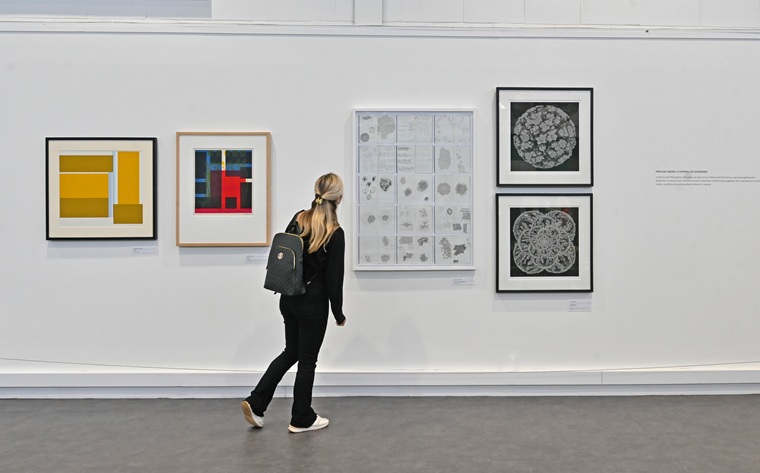
The University of Stirling Art Collection is a living part of campus and community, connecting people through art and creative research.
Your support helps care for and conserve the Collection, ensuring these artworks are protected for the future and shared today. It also enables new acquisitions, supports our Artist in Residence programme, and helps us bring art beyond campus into schools, colleges and local communities.
By adopting an artwork, you help preserve and share the Collection for generations to come, becoming part of its ongoing story.
Thank you.
Be part of the story
As a thank you for your support:
- Your name will be displayed beside your adopted artwork and on the Art Collection’s online catalogue.
- You'll receive a personal thank you from the Head of Collections, sharing the story, history or significance of the artwork you have chosen to support.
- If you choose to hear from us, we’ll share stories, updates, events and invitations to discover more about the artworks you are helping to care for.
How to adopt an artwork
-
Choose an artwork
Browse our featured selection or tell us about a piece you’d like to adopt. -
Set up your gift
Make a regular donation to the Art Collection Fund - monthly from £10, quarterly from £30 or annually from £120. -
Tell us your choice
Select your artwork during the donation process or choose “other” and let us know your preference. -
Stay connected
You’ve become part of the story of art at Stirling. We’ll send you a personal thank you and, if you’re happy to hear from us, occasional updates, stories and invitations to events.
About your artwork adoption
What your gift supports
Your gift supports the care, conservation and development of the Art Collection, helping to protect artworks for the future, support new acquisitions and enable creative opportunities through the Artist in Residence programme.
Choose how you give
Set up a donation monthly, quarterly or annually (from £10). Your support will continue until you choose to pause or cancel.
Supporting the wider collection
You are supporting your chosen artwork and the wider Collection, ensuring it can be enjoyed by many. Others may also support the same work.
Your artwork on display
Artworks may be displayed, stored or loaned to maximise access and ensure their care. If your chosen work comes off display within three months, we’ll help you choose another.
Featured artworks
Discover highlights from the Art Collection and adopt your favourite today.
The Fergusson Collection at Stirling
In a landmark act of philanthropy, J D Fergusson’s partner Margaret Morris wrote to Principal Tom Cottrell in late 1966 to say that a new Scottish University should have a collection of work by significant twentieth-century Scottish painters, and she therefore wished to give a representative collection of Fergusson’s pictures to the new institution. Fourteen works that span Fergusson’s creative practice were gifted in 1967.
/filters:format(webp)/filters:no_upscale()/prod01/cdn/media/stirling/about-us/alumni-and-supporters/images/The-Red-Shawl-578X358.jpg)
Oil on canvas, 1908. Fergusson was known for his portraits of strong, confident women. This portrait is of the American writer and critic Elizabeth Dryden, who was sent to Paris in 1905 by her employer, Rodman Wanamaker, to write fashion reviews for his department store trade magazine. These were to be illustrated by her friend Anne Estelle Rice. Both women sat for Fergusson on numerous occasions.
/filters:format(webp)/filters:no_upscale()/prod01/cdn/media/stirling/about-us/alumni-and-supporters/images/Rhythm-578X358.jpg)
Oil on canvas, 1908. Rhythm was a key modernist concept, expressing harmony in nature alongside vigour and directness. This painting is considered Fergusson’s first modernist masterpiece and was used as the cover for the literary magazine Rhythm, where he served as art editor. It depicts a proud, Eve-like female figure, self-assertive rather than passive, with tension created through contrasting vertical and fluid forms.
/filters:format(webp)/filters:no_upscale()/prod01/cdn/media/stirling/about-us/alumni-and-supporters/images/The-Feather-Boa-578X358.jpg)
Oil on canvas, 1904. Fergusson was known for his admiration of strong, stylish women, a theme reflected in this portrait of his friend Jean Maconochie. Painted when feather boas were at the height of fashion, the portrait captures Jean Maconochie standing confidently, one hand on her hip, projecting both elegance and self-assurance.
/filters:format(webp)/filters:no_upscale()/prod01/cdn/media/stirling/about-us/alumni-and-supporters/images/StirlingUniArtCollection049.JPG)
Bronze, 1959. Barbara Hepworth was a modernist sculptor who was a leading figure in the St Ives group of artists. The acquisition of this work from Hepworth in 1967 reflects the ambition of the newly founded University to establish an important collection of contemporary art.
Archaean is an abstract sculpture representing the human form standing in a landscape. Hepworth‘s art was primarily about relationships, and in particular the relationship between the human figure and the landscape. She said that she always imagined her sculptures in carefully considered outdoor settings, closely connected to the landscape. The landscape is central to life at Stirling, making the sculpture a natural part of its surroundings. It cuts an imposing figure in the first courtyard as you enter the Pathfoot Building, inviting visitors to reflect on their own relationship with the Collection and the wider campus landscape.
As with other outdoor artworks, your name will be featured in the Art Collection's online catalogue.
/filters:format(webp)/filters:no_upscale()/prod01/cdn/media/stirling/about-us/alumni-and-supporters/images/Interior-Dialogue-578X358.jpg)
This artwork was created in response to Christine Borland‘s long-held emotional and intellectual engagement with the work of sculptor Barbara Hepworth. Interior Dialogue responds to Barbara Hepworth's Oval Sculpture (1943). It recreates the hollowed interior of Hepworth's sculpture as a solid form, revealing spaces ‘hidden’ within the sculpture.
Central to the ideas behind Interior Dialogue is to make visible an absence or a presence that, without careful and intimate consideration, would go unseen. This echoes themes within the art created by the St Ives artists like Hepworth exploring form and void, and the way in which space around and within an object play a part in giving it form.
Interior Dialogue is deliberately sited alongside Barbara Hepworth’s Archaean sculpture in the Pathfoot Building so that the relationship between the works can be explored and the people who pass by become an integral part of that dialogue.
Explore more artworks
- Bathers, noon, J D Fergusson
- Night Sky: Magda, Jon Schueler
- Martyr, Robin Philipson
- Cool Interior - A Remembrance, Robin Philipson
- Wall Construction, Mary Martin
- Mh10, Colin Cina
- Icelandic Tapestry; Fire and Ice, Sam Ainsley,
- An Teallach between Ristol and Mullagrach, James Morrison
- Inverkirkaig to Suilven, Philip Hughes
- Transition. A word-map of Northumberland AONB coastline, Alec Finlay
- Nanbei, Kate Downie
Any artwork in the Collection including our sculptures can be adopted. Search the Art Collection.
If you have a particular artwork in mind that isn’t listed, please contact the philanthropy team at philanthropy@stir.ac.uk and we’ll be happy to help.
University Collections and the Pathfoot Galleries are fully accredited by Museums Galleries Scotland.
The Art Collection is