
Study uncovers complex history of plague after the Black Death
University of Stirling historian Professor Philip Slavin was involved in the research
/filters:format(webp)/filters:no_upscale()/prod01/cdn/media/stirling/news/news-centre/2026/sep-26/Headstone-with-skull-and-crossbones-in-Greyfriars-Kirkyard,-Edinburgh,-Scotland-1200X630.jpg)
The Black Death is often remembered as a single catastrophic event that swept across Europe between 1347 and 1353, killing millions, yet the disease did not disappear after that first devastating outbreak, research has shown.
For more than four centuries, plague continued to return in recurring waves, reshaping communities, economies and societies across Europe and beyond.
A new study involving University of Stirling historian Professor Philip Slavin analyses the DNA of the plague bacterium preserved in archaeological human remains.
Led by researchers at the University of Tartu, a team reconstructed 26 genomes of Yersinia pestis, the bacterium responsible for plague, from 11 archaeological sites in Estonia, Russia, England, the Netherlands and Switzerland.
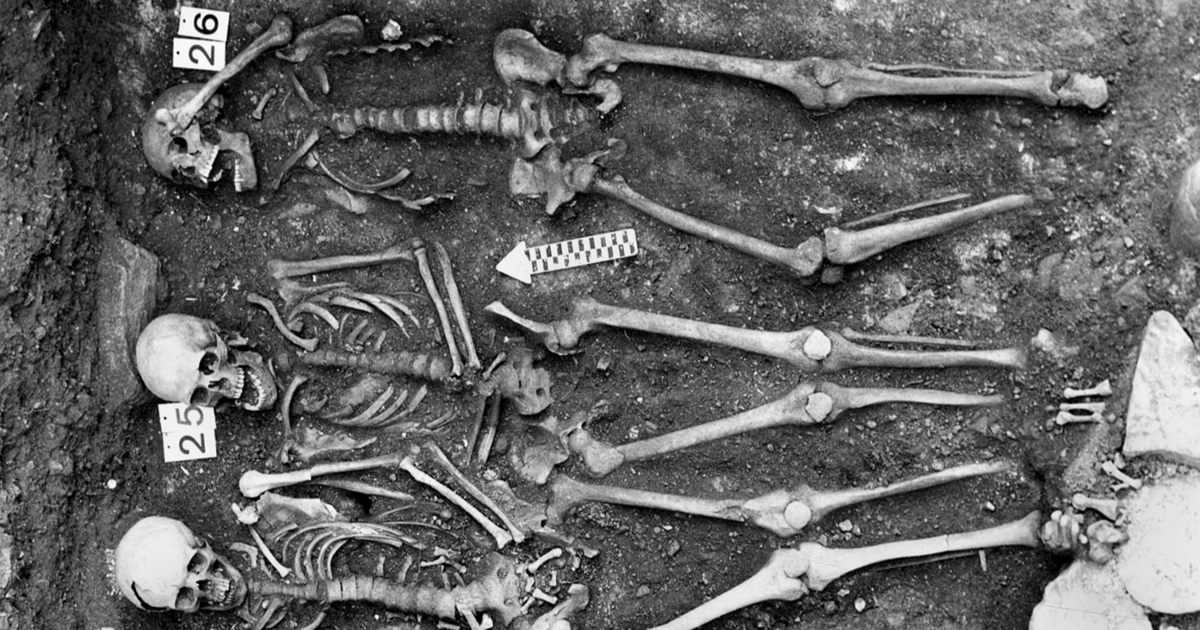 Plague victims from Domat/Ems, Sogn Pieder (Switzerland) associated with the Plague of the Thirty Years’ War
The samples span a period from the fourteenth to the eighteenth centuries, covering much of the so-called Second Plague Pandemic.
The results reveal the complex history of plague with unprecedented resolution. Rather than persisting in a single location after the Black Death, plague repeatedly resurfaced in different parts of Europe over several centuries, seeding multiple new reservoirs.
The researchers found evidence that plague was introduced multiple times into Estonia throughout much of the Second Plague Pandemic, showing that close connections with other parts of Europe also facilitated the spread of disease.
Notable findings
One of the study's most notable findings was evidence of a major expansion of plague lineages around 1450–1500. During this period, the bacterium diversified into three major branches that may have established new reservoirs in wild rodent populations.
The researchers speculate that climatic changes could have played a role. One possible factor is the Great Renaissance Drought. Modern studies have shown that climate strongly influences plague outbreaks among wild rodents, which serve as natural reservoirs of the disease.
One of the most innovative aspects of the study was a new method for assigning historical plague outbreaks to recovered plague genomes.
The importance of this approach can be illustrated by comparing it with the COVID-19 pandemic. During the coronavirus crisis, scientists were able to track the spread of different variants because genome sequences came with precise collection dates. Historical pandemics are different: ancient remains are often dated only within broad radiocarbon intervals that can span more than a century.
Precise timestamps
Dr Marcel Keller, who led the study, said: “With COVID-19, scientists could reconstruct the spread of individual strains extremely well because the genomes came with precise timestamps. For historical pandemics, those timestamps are often missing or may cover more than 100 years, which limits our ability to interpret the genetic data.”
To overcome this challenge, the research team developed a method that improves the precision and accuracy of those intervals. By analysing the position of plague genomes on the bacterium's evolutionary tree, they were able to narrow down the likely dates of many samples and place them into a much clearer historical context.
Professor Philip Slavin, historian and co-author, said: “We were able to improve dating intervals for many samples, which allowed us to connect them to specific plague waves and outbreaks that were recorded in the respective towns or regions by chroniclers.”
 Professor Philip Slavin
The researchers then used these improved dates to reassess 64 previously published and 11 newly sequenced plague genomes. The result is the first systematic attempt to link nearly all currently available plague genomes from the fourteenth to eighteenth centuries with historically documented outbreaks.
The study also highlights how strongly human activity shaped the course of plague epidemics. Newly analysed genomes provide additional evidence for outbreaks associated with the Thirty Years’ War (1618–1648) and the Great Northern War (c. 1700–1721). According to the researchers, plague frequently spread along the same routes used by armies, refugees and traders.
More broadly, the research shows that plague was not a single historical disaster but a recurring threat that devastated cities and regions generation after generation.
Long-term dynamics
Although plague is no longer a major public health threat in Europe, the disease has not disappeared. Yersinia pestis still survives in natural rodent reservoirs in several parts of the world.
The researchers argue that understanding how plague established itself after the Black Death, persisted for centuries and eventually disappeared from Europe can help scientists better understand the long-term dynamics of infectious diseases.
By linking ancient plague genomes to historical outbreaks and potential reservoir populations, the study provides new insights into how pandemics emerge, spread and persist over time. Such knowledge may also contribute to modern disease surveillance and public health efforts to monitor contemporary plague foci.
The study was made possible through extensive international collaboration. Samples and expertise came from partners across Europe, including researchers at the University of Cambridge and collaborators in the Netherlands and Switzerland.
By combining ancient DNA research, archaeology, history and radiocarbon dating, the team has produced the most comprehensive genetic picture of the Second Plague Pandemic to date and provided new insights into how one of history's deadliest diseases shaped Europe for centuries.