
Funding boost for major Forth Valley tree-planting project
Forth Climate Forest, a partnership initiative hosted by the University, has been awarded more than £130,000 from NatureScot and Future Woodlands Scotland to work with communities to co-design tree and wildflower planting plans for their areas
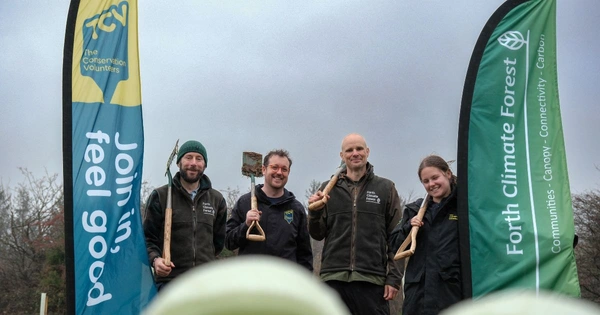
An ambitious University of Stirling-led project to plant 16 million trees across the Forth Valley has received a funding boost to help communities shape plans in their area.
Forth Climate Forest, a partnership initiative hosted by the University, has been awarded more than £130,000 from NatureScot and Future Woodlands Scotland to appoint a consultant to work with communities in Clackmannanshire, Falkirk and Stirling to co-design tree and wildflower planting plans for their areas. The initiative is party of the Forth Climate Forest’s Strategy for Tree Equity and Pollinator Stepping Stones in the Forth Valley (STEPPS) Project.
As well as delivering environmental benefits, the forests will absorb carbon from the atmosphere, create places for wildlife to thrive and support improved social and health benefits for local people.
Guy Harewood Development Officer of Forth Climate Forest said: "Since we launched the Forth Climate Forest in 2023 community engagement has been at its heart. We want to hear from local people so that they have a real say in shaping how we tackle biodiversity loss and mitigate against the damaging impacts of climate change.
"By creating opportunities for local action, substantial new tree and woodland planting across the Forth Valley has empowered local communities, while also ensuring that neighbourhoods are better adapted to cope with extreme weather events."
Forth Climate Forest is part of a network of four Climate Forests across the central belt that will lead projects to plant 35 million trees by 2035, reducing flooding and temperature extremes, purifying air, and absorbing carbon - delivering lasting ecological, climate, and social benefits.
Community-centred
Work is already underway to engage with communities in Sauchie in Clackmannanshire, Grahamston, Middlefield and Westfield, Bainsford, Langlees and New Carron and Grangemouth community councils in Falkirk and Raploch in Stirling.
The project has already worked closely with communities across the Forth Valley to increase tree canopy in neighbourhoods that have the fewest trees, as well as supporting farmers and landowners to develop and plant new native woodlands.
Guy added: "The communities within the five new areas we’re working on have been really engaged in the process and keen to do all they can to identify places where there is a lack of tree canopy and where planting can be most impactful."
NatureScot’s Head of Fundraising, Iain Sime said: "The STEPPS project from Forth Climate Forest will not only help restore native trees, plants and wildflowers but it will also offer many benefits for local communities and wildlife.
"Through the Nature Restoration Fund, we’re able to provide vital development funding to projects to help maximise the benefits for people and nature while restoring habitats in the most sustainable and cost-effective ways."
Supporting success
Des Hackett, Urban Forestry Programme Manager, Future Woodlands Scotland added: "STEPPS is exactly the kind of project we want to support through our Urban Forestry Programme. We know that successful urban forestry is about more than simply planting trees. It's about understanding how people use and value the places around them, then using that knowledge to shape future investment.
"By putting communities at the heart of the process, STEPPS will help ensure future planting delivers lasting benefits for both people and nature across the Forth Valley."
The Forth Climate Forest covers Clackmannanshire, Falkirk and Stirling Councils, as well as a large part of Loch Lomond and The Trossachs National Park.
It is a partnership initiative, hosted by the University of Stirling through Scotland’s International Environment Centre (SIEC). SIEC is supported by £5m in funding from the UK Government and £17m from the Scottish Government through the Stirling and Clackmannanshire City Region Deal.