
Stirling scientists monitor Manhattan-sized glacier break
Two even larger ice islands are expected to break away in the near future
/filters:format(webp)/filters:no_upscale()/prod01/cdn/media/stirling/news/news-centre/2026/aug-26/Petermann-Glacier.-Credit_-Adam-Garbo.jpg)
Stirling scientists are part of an international team monitoring a major glacier break in Greenland that has created a Manhattan-sized ice island.
The group, which includes Stirling's Dr Anna Crawford and Dr Iain Wheel, warn that two even larger ice islands are expected to break away in the near future.
The scientists report that a 76.4 sq km section of Petermann Glacier in northwest Greenland calved – when a glacier splits and a large piece breaks off – on 4 August, marking the glacier's largest loss of floating ice since 2012 and the largest Arctic calving event since 2020.
The newly formed tabular iceberg, estimated to be up to 150 metres thick, presents a rare opportunity to study how large Arctic ice masses form, drift and break apart over time, according to researchers.
Dr Anna Crawford, Senior Lecturer in Physical Geography at the University of Stirling, said: “While large, tabular icebergs are relatively common in the Southern Ocean that surrounds the Antarctic Ice Sheet, Arctic ice islands are far rarer. By studying Arctic ice islands, we will gain knowledge that can be transferred across Polar regions.”
 Dr Anna Crawford
The calving event was detected by Adam Garbo, a PhD student in glaciology at the University of Ottawa, as part of an international collaboration between the University of Ottawa, the University of Stirling, Environment and Climate Change Canada, Lancaster University and the University of Leeds.
Scientists used long-term satellite monitoring that have tracked changes at Petermann Glacier since 2019. Researchers have been following the glacier’s floating ice tongue, documenting the growth of fractures and monitoring signs of instability over several years.
Adam Garbo said: “Petermann Glacier has long been one of Greenland’s largest remaining ice tongues. We’ve anticipated this break for years and seeing it finally happen is remarkable.”
Satellite imagery from the European Space Agency’s Sentinel-1 mission showed clear deterioration along the centreline of the ice tongue on 3 August. By 4 August, the new ice island had detached from the eastern side of the glacier.
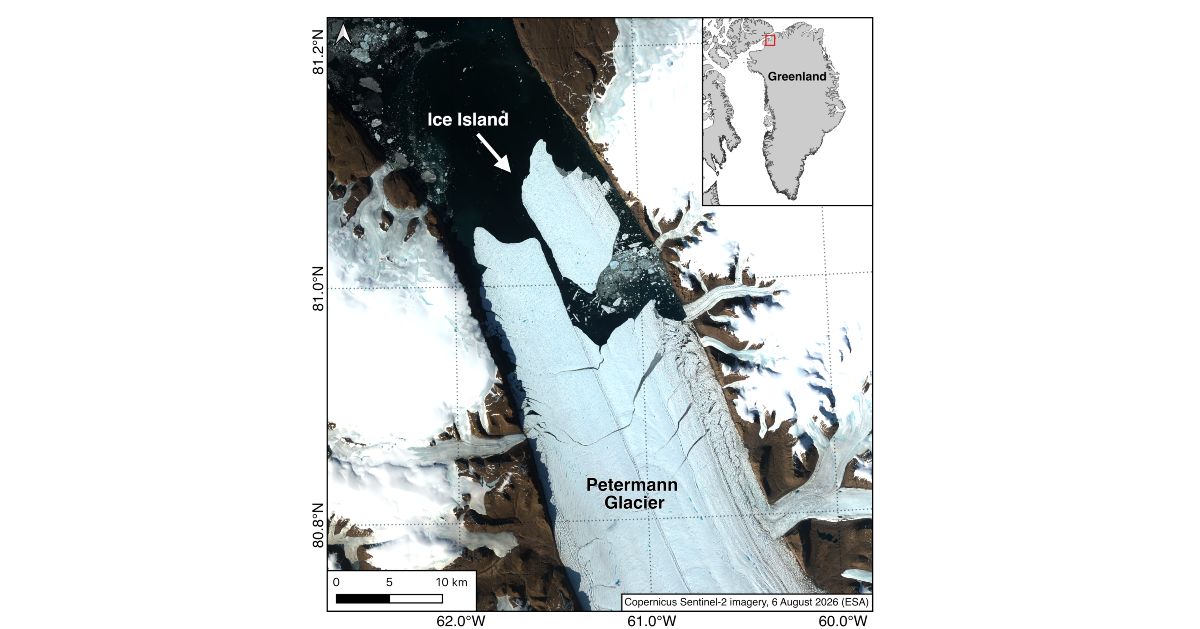 Satellite imagery of the Petermann Glacier.
Large Arctic ice islands are less common than the large tabular icebergs regularly seen in the Antarctic. They can persist for years, providing scientists with an important window into the processes that shape glacier retreat, ocean conditions and ice hazards in polar regions.
Researchers say the recent calving is unlikely to be the last. Two additional large ice islands are expected to detach from Petermann Glacier in the near future as long-developing rifts continue to cut across the ice tongue.
Those future calving events are projected to produce ice islands of approximately 94 sq km and 84 sq km. Together with the newly detached ice island, they would reduce the Petermann ice tongue by about 254 sq km, or 22 per cent.
Marine safety
Beyond its scientific importance, the new ice island also has practical implications for marine safety. As these massive blocks of ice drift and gradually fracture, they can create hazards for shipping and offshore operations.
As with previous Arctic ice shelf calvings, Environment and Climate Change Canada is closely monitoring the movement of the new ice island and assessing potential hazards to Arctic navigation and offshore infrastructure.
Dr Abigail Dalton of the Canadian Ice Service, Environment and Climate Change Canada, said: “These are thick blocks of ice that can drift for years. Over time, they fracture into smaller, harder-to-track pieces that pose hazards to vessels and resource operations.”
Garbo and his collaborators will continue to monitor the aftermath of the event using satellite imagery, aerial observations and tracking data as part of a broader effort to understand the mechanisms driving the calving and retreat of Arctic ice shelves.